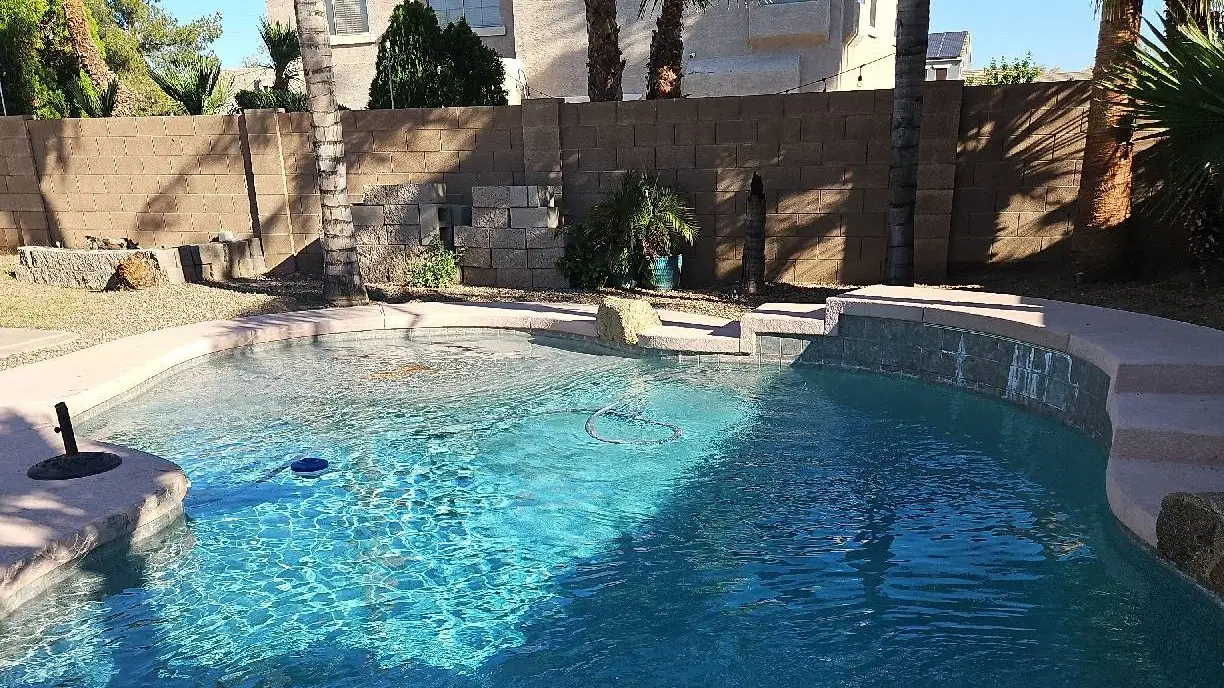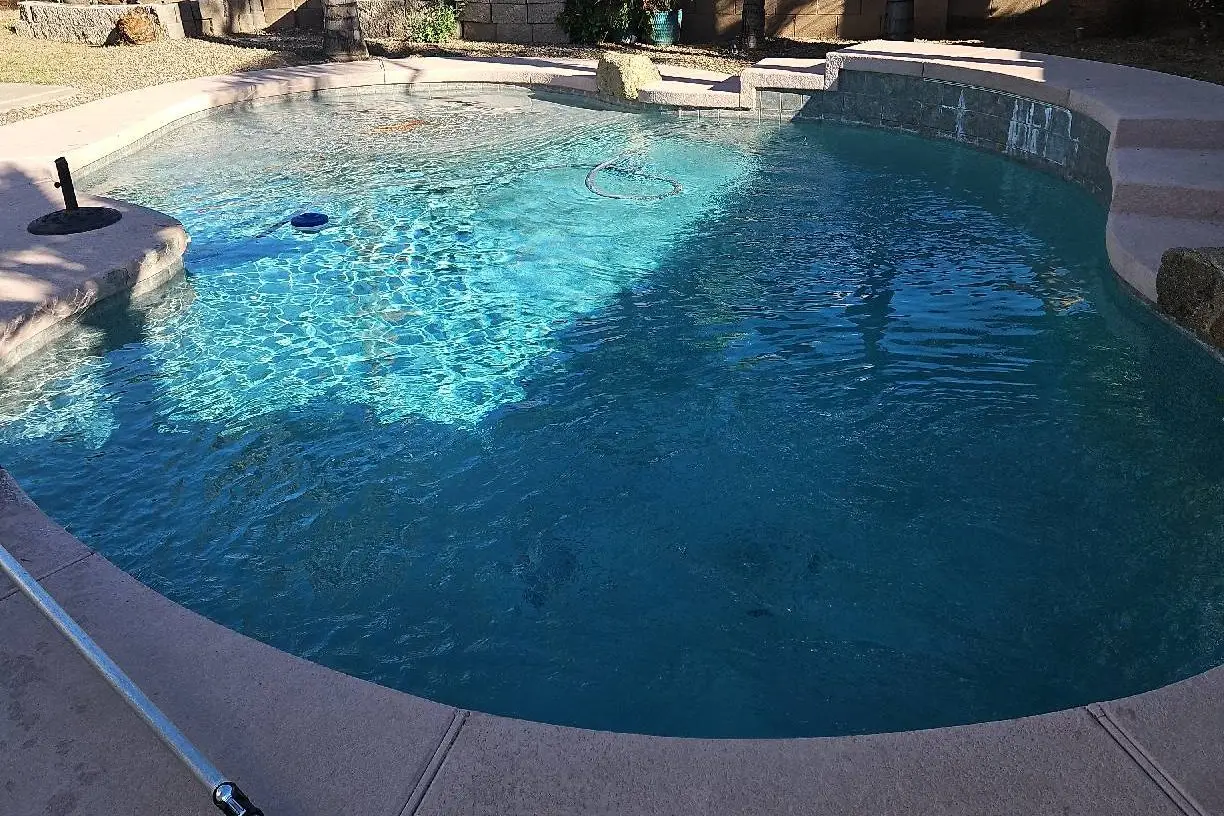
If you own a pool in Chandler, you have almost certainly battled that chalky white line that climbs up your waterline tile. You scrub it, and a few weeks later it is right back. It is one of the most common pool complaints we hear from Chandler homeowners, and there is a good reason for that: Chandler has some of the hardest water in the entire East Valley, so calcium builds up here faster than in most nearby towns.
The frustrating part is that scale is not a sign you did anything wrong. It is simply what happens when very hard water meets a hot, dry climate. The encouraging part is that it is completely manageable once you understand what is going on. Below, we break down what that white buildup actually is, why Chandler pools get it so badly, how to remove it at every stage, and the handful of habits that keep it from taking over again.
What That White Stuff on Your Tile Actually Is
The chalky ring on your tile is calcium scale. Your tap water carries a heavy load of dissolved minerals, mostly calcium and magnesium, which is what makes water “hard.” When your pool water evaporates in the Chandler heat, the water leaves but the minerals stay behind. They bond to your tile, your plaster, and the inside of your equipment as a hard, crusty deposit that gets more stubborn the longer it sits.
Calcium Carbonate vs Calcium Silicate
There are two kinds of scale you might be fighting, and knowing which one you have tells you how hard it will be to remove.
| Calcium Carbonate | Calcium Silicate | |
|---|---|---|
| Looks like | White, flaky | Dense, grayish-white |
| Reacts to acid? | Yes, fizzes | No |
| Removal | Pumice stone if caught early | Professional bead blasting |
A quick way to guess which you have: if a wet pumice stone takes the deposit off with reasonable effort, it is probably carbonate. If the scale just laughs at you, it is likely silicate, and that is a job for a pro.
Why Chandler Pools Get Calcium Buildup So Fast
Chandler homeowners are not imagining it. Your pools really do scale faster than a lot of neighboring areas, and it comes down to three things stacking up.
The water is extremely hard. Chandler draws heavily on groundwater from deep desert aquifers that sit beneath ancient limestone and caliche. As that water works its way through all that calcium, it picks up a heavy mineral load. The result is water that averages around 16.5 grains per gallon and climbs toward 20 in parts of town. For reference, anything above 10.5 grains per gallon is considered very hard, so Chandler is well past that line and sits among the hardest water in the Valley.
The heat drives constant evaporation. In peak summer, a Chandler pool can lose an inch or more of water a week. Every time you top it off, you add fresh, high-calcium water, which concentrates the minerals already in the pool and keeps feeding the problem all season long.
High pH pushes calcium out of the water. Arizona fill water tends to run high on the pH scale, and high pH makes dissolved calcium want to leave the water and cling to your surfaces. That is why balanced chemistry is such a big part of keeping scale under control. When pH drifts up and nobody catches it, scale accelerates.
It Is Not Just Your Tile
The waterline is where you notice calcium first because it is at eye level, but the same minerals are working on the rest of your pool too. Scale builds up inside your salt cell, which is why salt systems in Chandler need cleaning more often than in softer-water regions. It coats the inside of your heater, where it reduces efficiency and can eventually cause failures. It clogs the pores of your filter media, and it settles on your plaster and steps as a rough, chalky film. Treating the tile is important, but the real goal is keeping the whole system from scaling up, and that starts with balanced water and consistent care.

How to Get the Calcium Off Your Tile
Your best option depends on how far the buildup has gone.
Light, early buildup. If you catch it early, a pumice stone and some elbow grease can knock calcium carbonate off ceramic or stone tile. Keep both the stone and the tile wet the whole time so you do not scratch the surface, and work in small sections. This is fine for a handful of tiles, but it is slow, tiring going for an entire waterline, and it does nothing for silicate.
Moderate to heavy buildup. This is where professional pool tile cleaning earns its keep. We use bead or salt-media blasting to strip the scale off the entire waterline without harming the tile, and it comes back looking like new. It is faster, safer for your tile, and it handles the tough silicate scale a pumice stone cannot touch. For most Chandler pools, a professional tile cleaning restores that clean, bright waterline in a single visit.
Scale plus stained or rough plaster. When calcium has spread to your plaster and steps and the finish is stained or rough, a full acid wash strips the surface back to a clean, bright finish. This is the move for older Chandler pools that have gone a long time without attention, and there are plenty of those given how much of the city was built in the 1990s and 2000s. If the plaster is too far gone for an acid wash, our guide on whether to resurface or remodel can help you decide.
What Professional Tile Cleaning Actually Involves
If you have never had it done, here is what to expect. A technician lowers the water level slightly to expose the full scale line, then uses a media blaster that fires a soft abrasive, often glass beads or a mineral salt, at the tile under pressure. The media chips the calcium off without scratching the tile glaze underneath. It is contained, controlled, and surprisingly satisfying to watch, and the difference between a scaled and a freshly blasted waterline is night and day. It is the right tool for the heavy Chandler scale that DIY methods cannot budge.
Mistakes to Avoid
A few well-meaning DIY moves can do real damage, so it is worth knowing what not to do:
How to Slow It Down and Keep It From Coming Back
You cannot change the fact that Chandler’s water is hard, but you can keep scale from ever getting ahead of you. A few habits make the biggest difference:
How Often Should Chandler Pools Get Tile Cleaning?
There is no single number, because it depends on your water chemistry, how much your pool evaporates, and whether you run a salt system. That said, because Chandler’s water is so hard, most pools here benefit from a professional tile cleaning about once a year, and some heavily used or salt-chlorinated pools do best on a shorter cycle. If you keep your chemistry balanced and brush regularly, you can stretch that interval, and we keep an eye on it for you during weekly service.

Calcium and Chandler’s Salt Pools
Salt systems are popular across Chandler for the softer-feeling water and easier day-to-day chlorine handling, but there is a catch worth knowing about. Salt chlorinators naturally raise pH as they operate, and higher pH means faster scaling in our already hard water. On top of that, calcium builds up right on the salt cell’s metal plates, which slowly chokes its output. If you run salt, plan on more frequent tile attention and regular cell cleaning to keep everything working. We service and clean cells and install new salt systems sized for Chandler’s water so they hold up.
When to Call a Chandler Pro
If your tile scale is thick, gray, and laughs at your scrub brush, or if it has crept onto your plaster and steps, it is time to bring in help before it gets more expensive to fix. Our team handles everything from routine pool cleaning and tile cleaning to full acid washes across Chandler, from the lake homes of Ocotillo and Fulton Ranch to the established neighborhoods near downtown, and we will tell you honestly which one your pool actually needs. Learn more about our pool service in Chandler.
Chandler Pool Calcium FAQ
Is calcium scale bad for my pool, or just ugly?
Can I remove calcium without draining my pool?
Why does my tile scale up again so quickly in Chandler?
Will a home water softener help my pool?

Related Reading
Tired of fighting that white ring on your own?
Blue Lagoon Pool Management will get your Chandler pool’s tile clear and help you keep it that way.