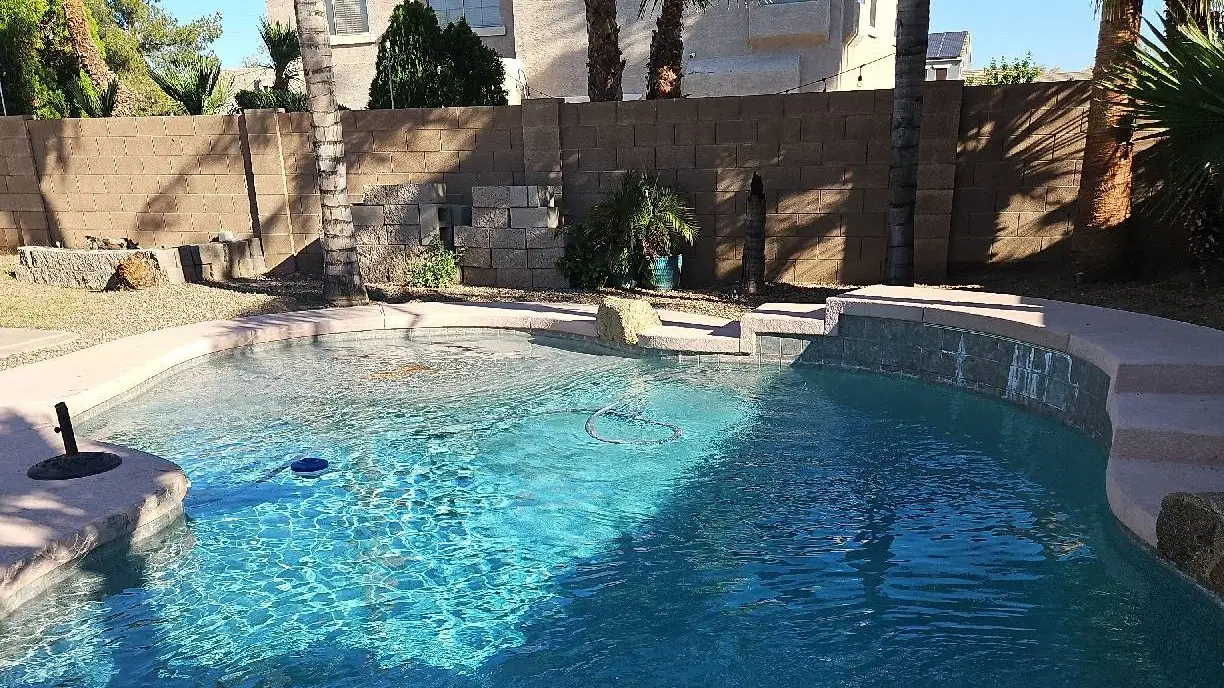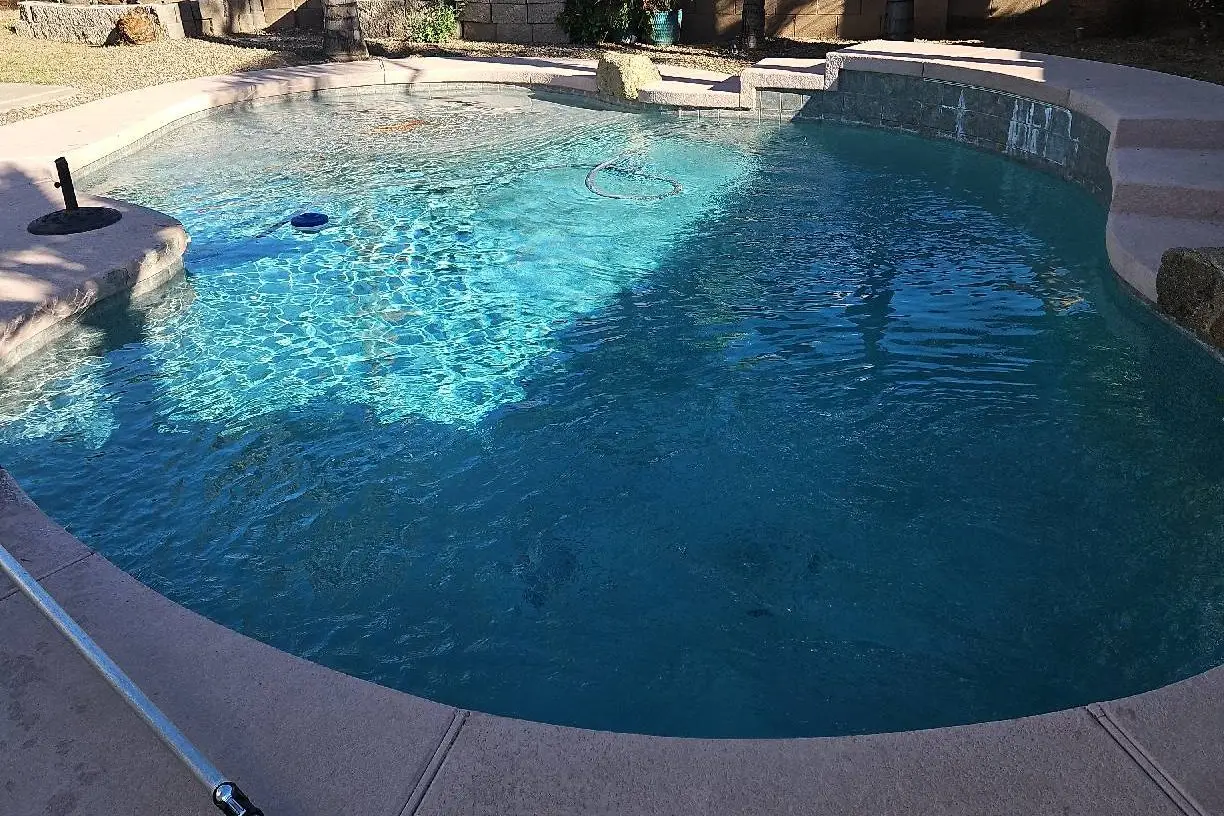
If you’ve noticed a white, chalky crust forming along your pool’s waterline, cloudy water that won’t seem to clear up no matter how much you shock it, or a filter that clogs faster than it used to – Gilbert’s hard water is likely the culprit.
It’s one of those things that sneaks up on you. You’re not doing anything wrong. You’re adding chemicals, running your pump, keeping the water looking decent. But underneath the surface, calcium and minerals are slowly scaling your tile, clogging your equipment, and eating into the lifespan of your plaster. Left unchecked, what starts as a cosmetic annoyance becomes a repair bill.
Here’s what’s actually happening, why Gilbert pools are especially vulnerable, and what you can do about it before it turns expensive.
Why Is Gilbert’s Water So Hard?
Gilbert’s water supply draws from a combination of groundwater wells and surface water routed through the Central Arizona Project (CAP). The groundwater in particular passes through limestone, gypsum, and caliche rock formations – geological features that are common throughout the Sonoran Desert. As water travels through those layers over hundreds or thousands of years, it picks up calcium carbonate and magnesium in enormous quantities.
The result is water that, by most measures, qualifies as “very hard” to “extremely hard.” Many Gilbert neighborhoods see calcium hardness levels in the water supply ranging well above 300 parts per million (ppm) before it even hits your pool. Add in Arizona’s brutal evaporation rates – especially during summer when your pool can lose inches of water per week – and the problem compounds quickly. When water evaporates, it takes nothing with it but the H₂O. Every mineral, every chemical, everything else stays behind in increasingly concentrated form.
In other words, the longer you run your pool through a Gilbert summer without a proper management plan, the harder and more mineral-saturated that water gets.
What Hard Water Actually Does to Your Pool
Understanding the damage is important, because it helps you prioritize what to deal with first.
1. Calcium Scale on Your Tile
The most visible symptom is the white or gray crusty buildup that forms along the waterline tile. This is calcium carbonate precipitating out of solution – essentially limestone forming on your pool’s interior surfaces. Early on, it looks like a thin film that wipes off. Over time, it hardens into a dense mineral crust that bonds aggressively to tile and grout and resists most standard cleaning products.
Beyond being unsightly, calcium scale traps algae, makes your waterline rough and sharp, and – if left long enough – can crack tile by expanding in pores during temperature changes.
Our pool tile cleaning service is specifically designed for this kind of buildup. Gilbert pools need a more aggressive approach than pools in cooler, less minerally-intense water markets, and that’s something we factor into every job.
2. Scaling Inside Your Equipment
What you can see on the tile is also happening inside your equipment – in your filter, your pump, your heater, and your salt cell if you have one. Scale builds up on internal components the same way it does on your tile, except you can’t see it until something stops working the way it should.
In filters, calcium scale dramatically reduces flow efficiency. In heaters, scale acts as insulation on the heat exchanger, forcing the unit to work harder and consume more energy to produce the same heat. In salt chlorinators, scale on the cell plates reduces chlorine output – a common reason Gilbert homeowners think their salt system is failing when it’s actually just coated in mineral buildup.
If you’ve noticed your pool filter cycling more frequently, your heater running longer than usual, or your chlorine output declining, hard water scale is the first thing to rule out.
3. Plaster Damage and Etching
Here’s where it gets more serious. Calcium scaling isn’t just a high-calcium problem – it’s also a chemistry balance problem. Water that is too low in calcium (below 200 ppm) becomes aggressive, meaning it actively leaches calcium carbonate out of your plaster to satisfy its mineral deficit. This causes etching: a roughening and pitting of the pool’s interior surface that feels like sandpaper underfoot and looks matte or patchy. If that roughness has spread across the whole pool, here is how to tell if your plaster needs resurfacing.
Both extremes – too much calcium causing scale, or too little causing etching – damage your plaster over time. In Gilbert, the more common issue is excess calcium, but pools that get partially drained and refilled repeatedly without proper rebalancing can swing in either direction.
4. Cloudy Water That Won’t Clear
When calcium hardness climbs past 400-500 ppm, the water itself starts to look milky or hazy even when your chlorine levels test normal. This is because the water is holding more dissolved minerals than it can comfortably keep in solution – and it starts “crashing out,” creating a visible cloudiness.
This is a frustrating situation because it doesn’t respond to shocking or algaecide the way algae-related cloudiness does. The fix requires addressing the chemistry imbalance directly, which sometimes means a partial drain and refill with properly balanced water.
The Specific Numbers Gilbert Pool Owners Should Know
If you’re testing your own water, here are the key targets for a Gilbert pool:
- Calcium Hardness: 200-400 ppm (aim for 250-350 as your Gilbert sweet spot)
- Total Alkalinity: 80-120 ppm
- pH: 7.4-7.6 (hard water tends to push pH up; keep it dialed in on the lower end of acceptable)
- Cyanuric Acid (Stabilizer): 30-50 ppm (Arizona sun destroys unstabilized chlorine fast)
- Chlorine: 1-3 ppm free chlorine
The Langelier Saturation Index (LSI) is a more sophisticated calculation that factors all of these together – including temperature – to tell you whether your water is net-scaling or net-corrosive. A professional water test can calculate this for you and give you a more complete picture than any home test strip.
What You Can Do About It
Regular Tile Brushing and Treatment
Keeping your waterline tile brushed on a weekly basis is the single easiest way to prevent mild calcium scale from hardening into a serious problem. The longer you let it sit, the more work it takes to remove. This is something a quality weekly pool service should be doing automatically – not something you should have to request.
At Blue Lagoon, our weekly service includes brushing as a standard component, not an upsell.
Professional Tile Cleaning for Established Scale
If the scale has already hardened, brushing alone won’t touch it. At that point, you’re looking at professional tile cleaning – which typically involves bead blasting or specialized chemical treatments that break down calcium carbonate without damaging the tile or grout underneath. This is something we do regularly for Gilbert homeowners who’ve had scale build up over one or more seasons.
Acid Washing for Severe Cases
When scaling and staining have penetrated the plaster surface – not just the tile – an acid wash strips a thin layer of the plaster to reveal a fresh surface underneath. It’s a more involved process that requires draining the pool, but it’s one of the most effective ways to restore a pool that’s been allowed to deteriorate significantly. It’s not something you need every year, but knowing when it’s the right call can save you from a full replaster job down the road.
Consistent Water Chemistry Management
The most effective long-term solution is keeping your water chemistry consistently balanced so that scale never gets the opportunity to form in the first place. This means testing weekly during summer – not monthly – and making small adjustments regularly rather than large corrections periodically.
Gilbert’s summer evaporation rates mean your water chemistry can shift meaningfully in just a few days during peak heat. If you’re relying on monthly testing, you’re flying blind for most of the season.
When It’s Time to Call a Professional
Most Gilbert homeowners can handle light chemical maintenance on their own, but hard water damage has a way of compounding faster than expected – especially during summer when you’re busy and the heat is relentless.
Here are the signs that it’s time to bring in a pro:
- Calcium scale that you can no longer brush off the tile
- Waterline buildup that’s come back within weeks of you cleaning it
- Cloudy water that doesn’t respond to shocking
- Filter pressure that spikes quickly after cleaning
- Any visible pitting, roughness, or discoloration on the plaster surface
- Reduced performance from a salt chlorinator
We’ve seen plenty of Gilbert pools that went from minor scaling to significant damage in a single summer because the underlying chemistry wasn’t being managed correctly. The good news is that most of the damage is reversible if you catch it early enough.
The Bottom Line for Gilbert Pool Owners
Your water supply is working against your pool every single day. That’s just the reality of owning a pool in Gilbert, AZ. It doesn’t mean you can’t have a beautiful, well-maintained pool – it just means the maintenance approach here needs to be more intentional than it would be in a lower-hardness water market.
The right combination of consistent weekly service, proactive tile cleaning, and periodic professional water analysis will keep hard water damage from ever becoming a serious problem. But once it gets ahead of you, the repairs get expensive fast.
If your pool is showing any of the signs we covered above – or if you just want to know where your water chemistry actually stands – contact us for a straight, honest assessment. No pressure, no runaround. That’s how we do things.
Related Reading
Blue Lagoon Pool Management has been serving Gilbert, Chandler, Mesa, Tempe, Queen Creek, and San Tan Valley since 2010. We’re a family-owned team that knows Gilbert pools – including what Gilbert’s water does to them. Call us at (480) 400-0140 or request a free quote online.